

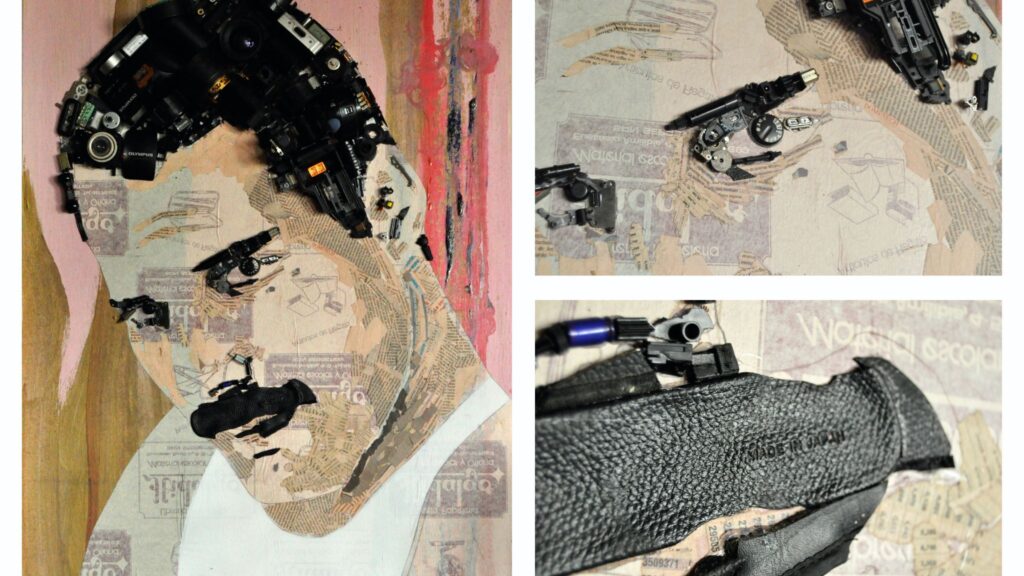
To the global audience, he was the pinnacle of Dionysian extravagance — a force of nature capable of commanding stadiums with a snap of his fingers. Yet behind the ermine capes and volcanic stage presence, the journey of Freddie Mercury (born Farrokh Bulsara) stands as one of the most compelling narratives of self-invention in art history.
His transformation was not accidental, but a masterclass in how geographic displacement and academic training in design can fuel unprecedented artistic ambition. What follows are five insights that reveal his genius was both biological and deliberately engineered.
1. The Refugee and the “Designer” of Royalty: From Zanzibar to the Queen Crest
Freddie’s resilience was forged in chaos. In 1964, his family fled the Zanzibar Revolution, a violent upheaval that forced thousands of people of Arab and Indian descent to escape.
Arriving in England as a refugee, young Farrokh worked as a baggage handler at Heathrow Airport — a humble beginning that sharply contrasts with the regal identity he would later construct.
What many overlook is that Freddie was formally trained in graphic design at Ealing Art College. This background became fundamental to Queen’s identity. He not only named the band Queen, but also designed its iconic crest, combining the members’ zodiac signs around a phoenix.
Queen, to him, was not just a band — it was a fully realized visual and symbolic concept.
“Back then, I didn’t really know him as a singer — he was just my mate. My crazy mate!” — Roger Taylor
2. The Biology of the Growl: Subharmonics and Vestibular Folds
Freddie Mercury’s voice remains a scientific curiosity. He had four extra incisors, which pushed his teeth forward. Though self-conscious about his appearance, he refused dental correction, believing it contributed to his unique resonance.
Technically, he was a baritone who could perform in a tenor range with extraordinary control.
A 2016 study led by Professor Christian Herbst found that Freddie used subharmonics produced by the vibration of the vestibular folds (false vocal cords) — a rare technique more common in Central Asian throat singing than in Western music.
This is what created his iconic rock “growl,” allowing him to shift from crystal clarity to raw aggression in seconds.
“His technique was astonishing… he could glide effortlessly between registers.” — Montserrat Caballé
- Reinvention as Art: 5 Surprising Lessons from the Legacy of Madonna
- Freddie Mercury: 5 Insights That Change the Way You Hear the King of Queen
- Disco Fever: The 1970s Dance Craze That Took Over the World
- The CB Radio Craze of the 1970s: America’s First Social Network
- Only True 80s Fans Can Name These Songs From One Line
3. The Broken Stand and the Engineering of Stadium Intimacy
Freddie’s signature half microphone stand was born from accident. During an early performance, the base broke off — and instead of stopping, he embraced it.
That broken stand became an extension of his body.
From a performance standpoint, this was revolutionary. Brian May often noted Freddie’s ability to make even the person in the last row feel personally connected.
The stand wasn’t just a prop — it was a scepter. With it, he collapsed the distance between performer and audience, turning massive crowds into intimate exchanges.
“He took theatrical rock further than anyone… he could hold an audience in the palm of his hand.” — David Bowie
4. Intuitive Genius: Harmonic Complexity Without Formal Notation
Here lies a fascinating paradox: the composer of Bohemian Rhapsody — a structurally complex, non-linear masterpiece — openly admitted he could barely read sheet music.
Freddie composed primarily on piano, guided by instinct rather than formal theory. He described his process as “cinematic.”
This freedom allowed him to jump effortlessly between styles — from rockabilly to disco-funk to opera. His so-called “ignorance” of theory was actually his greatest advantage: he didn’t know what wasn’t allowed.
“I hate doing the same thing over and over…” — Freddie Mercury (1986)
5. The Cat Lover: Vulnerability Behind the Myth
On stage, Freddie was a Dionysian titan. At home, in Garden Lodge, he was a devoted caretaker of his cats.
He owned at least ten at once — Jerry, Tom, Delilah, Tiffany, and Goliath among them — treating them as family. While on tour, he would even call home just to hear them.
This reveals a more fragile and private side of a man who needed refuge from fame.
His solo album Mr. Bad Guy (1985) includes one of the most revealing dedications in rock history:
“This album is dedicated to my cat Jerry… and all cat lovers across the universe — screw everybody else!”
Conclusion: A Legacy That Refuses to Be Ordinary
Freddie Mercury’s impact on Western culture is immeasurable. When he died in 1991 from complications related to HIV/AIDS, he became one of the first major rock stars to bring global attention to the disease.
Through the Mercury Phoenix Trust, his legacy became a force for awareness and change.
Freddie lived in constant fear of mediocrity. His legacy isn’t just in the notes he reached — but in his refusal to ever be ordinary.
As he once told his manager, Jim Beach:
“You can do whatever you want with my music — just don’t make me boring.”
Engagement Question
If Freddie Mercury were alive today, which musical genre do you think he would be reinventing or disrupting?
Share your thoughts.
Leave a Comment